

A Perspective Paper for Industry Stakeholders By CIEL HR
Executive Summary
India’s Labour Codes represent one of the most significant workforce reforms undertaken since independence. By consolidating 29 central labour laws into four broad codes, the reforms seek to simplify compliance and enhance ease of doing business. More importantly, these reforms could fundamentally reshape India’s labour market by formalising a large segment of economic activity while enabling greater agility in workforce deployment.
For the staffing and workforce solutions industry, the implications are particularly significant. The reforms are expected to accelerate workforce formalisation, legitimise flexible employment structures, and create a stronger foundation for fixed-term and project-based hiring models. They are also likely to strengthen the position of organised staffing companies that possess the scale, governance standards, and technology capabilities required to operate in an increasingly compliance-driven environment.
An equally important dimension of the reforms lies in their impact on India’s growing gig and platform economy. India’s gig workforce is estimated at nearly 12 million workers in FY26 and is projected to almost double by FY30. The broader definition of “Gig Worker” under the Social Security Code now extends beyond app-based platform workers to include freelancers and independent professionals operating outside traditional employer-employee relationships.
As India evolves into a globally competitive economy shaped by digitalisation, manufacturing growth, GCC expansion, AI adoption, and changing workforce preferences, the Labour Codes could become a catalyst for the next phase of growth in the staffing industry.
Understanding the Labour Codes
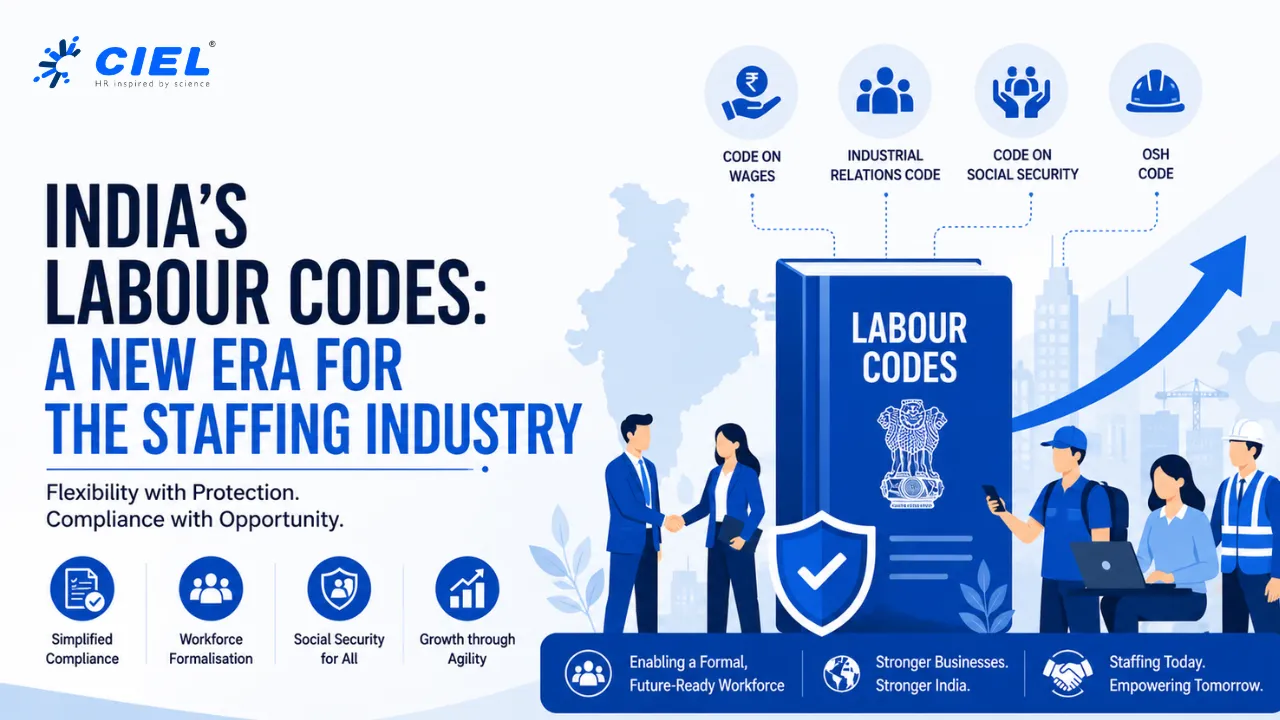
The Government of India has consolidated 29 central labour laws into four Labour Codes: the Code on Wages, the Industrial Relations Code, the Code on Social Security, and the Occupational Safety, Health and Working Conditions (OSH) Code.
The objective behind these reforms is not merely simplification of labour laws. The larger ambition is to create a labour framework aligned to the realities of a modern economy, one that balances worker welfare with business competitiveness, employment generation with flexibility, and governance with ease of compliance.
India’s economy today is far more dynamic and interconnected than it was when many of the earlier labour laws were framed. Businesses increasingly operate across multiple states, industries are becoming project-driven, and workforce structures are evolving rapidly. The Labour Codes acknowledge this changing reality.
Why the Labour Codes Matter to the Staffing Industry
Over the last two decades, India’s staffing industry has evolved from being viewed primarily as a provider of temporary manpower to becoming an increasingly strategic workforce partner for enterprises. Organisations today seek workforce agility, specialised talent, scalable hiring models, and workforce solutions that can adapt quickly to market fluctuations.
However, the sector has historically operated amid fragmented labour regulations, differing state-level interpretations, complex compliance structures, and inconsistent societal acceptance of flexible employment models. These factors often created operational friction and limited the pace of formalisation.
The Labour Codes address several of these structural challenges simultaneously. They not only simplify compliance frameworks but also provide legal and policy recognition to workforce models that are increasingly becoming central to modern economic activity.
This marks an important transition for the industry, from a traditional “contract manpower” ecosystem to a more formalised, technology-enabled workforce solutions sector.
Shift of Gig Work to Staffing Models
One of the most consequential shifts under the Labour Codes is the expansion of social security coverage to gig workers, platform workers, fixed-term employees, and contract workers.
The significance of this reform extends far beyond compliance. It reflects an acknowledgment that economic value creation today increasingly occurs outside traditional employer-employee relationships.
The broader definition of “Gig Worker” under the Social Security Code now includes not only platform workers but also freelancers and independent professionals. This substantially expands the scope of workforce formalisation in India.
The creation of mechanisms such as e-Shram registration and Aadhaar-linked portability of benefits could improve workforce visibility, continuity of social security benefits, and long-term employability for workers. At a structural level, these measures may gradually encourage workers to move toward more formal and compliant workforce ecosystems.
For organised staffing companies, this creates a significant opportunity. Staffing firms will become providers of structured employment, workforce continuity, compliance assurance, and long-term employability pathways.
- The Shift Towards Flexible Workforce Models
Across the world, workforce structures are becoming more agile. Organisations increasingly rely on contingent staffing, project-based teams, managed services, and specialised temporary talent to respond to changing market conditions. India, too, has gradually been moving in this direction over the past two decades.
The Labour Codes provide an important institutional endorsement of this shift. By extending statutory protections and formal recognition to flexible employment arrangements, the reforms are likely to improve confidence among workers as well as employers.
This is particularly relevant for India because flexible employment has often been viewed through the lens of insecurity rather than opportunity. The new framework attempts to create a balance between workforce flexibility and worker protection. Over time, this could deepen acceptance of staffing and contingent workforce models across industries.
- Formal Recognition of Fixed-Term Employment
One of the most transformative aspects of the reforms is the formal recognition of Fixed-Term Employment (FTE). This enables organisations to hire employees for defined periods while extending statutory benefits comparable to those available to permanent employees.
This reform is especially important in an economy that is becoming increasingly project-driven and demand-variable. Sectors such as manufacturing, retail, e-commerce, logistics, pharmaceuticals, IT services, GCCs, and infrastructure frequently require workforce flexibility to respond to seasonal demand, business cycles, and project timelines.
The recognition of fixed-term employment reduces ambiguity in hiring structures and legitimises short-duration formal employment. For staffing firms, it creates opportunities to design more specialised workforce solutions aligned to the changing needs of businesses.
- Why Platform Businesses May Increasingly Engage Staffing Companies
The Labour Codes may also alter the economics and operating models of platform businesses and aggregators.
The requirement for aggregators to contribute toward social security funds for gig workers, combined with growing expectations around digital compliance, grievance redressal, and workforce reporting, could increase the complexity of workforce administration.
As compliance obligations rise, many aggregators and employers may increasingly prefer organised staffing companies that possess the capability to find workers and manage workforce governance at scale. Staffing-led deployment models can help reduce administrative burden while still preserving operational flexibility.
This shift could be particularly relevant in sectors where large distributed workforces are common, such as logistics, delivery, retail operations, field sales, and customer support services.
- Simplification of Compliance and National Scalability
Historically, staffing companies operating across multiple states navigated a highly fragmented compliance landscape involving numerous registrations, contractor licences, registers, and returns.
The Labour Codes aim to simplify this through unified definitions, digitised compliance systems, common registrations, and technology-driven governance frameworks.
One of the most important changes is the possibility of a single national licence for contractors operating across India under the OSH Code. This has the potential to significantly improve scalability for staffing firms by reducing repetitive registrations and simplifying multi-state operations.
For organised staffing companies, these reforms could lower operational friction, accelerate client onboarding, and improve service consistency across geographies.
- Improved Worker Experience and Employment Quality
The Labour Codes place considerable emphasis on wage transparency, statutory protections, benefit parity, and formal documentation. Fixed-term employees are entitled to benefits comparable to permanent employees performing similar work.
This could improve worker trust and strengthen the perception of staffing employment as a legitimate and structured career pathway rather than merely a temporary arrangement.
Another important reform is the provision enabling fixed-term employees to become eligible for gratuity after one year of service instead of five years. While this may increase cost obligations for employers and staffing firms, it also enhances the attractiveness of formal employment and improves workforce confidence.
- Organised Staffing Firms Are Likely to Benefit Disproportionately
As the workforce ecosystem becomes more compliance-driven and digitally governed, organised staffing firms with strong governance standards, technology platforms, and scalable operating models are likely to gain competitive advantage.
Clients today are increasingly prioritising compliance assurance, ESG alignment, workforce transparency, and reputational risk management. This naturally favours organised workforce solutions providers over fragmented or informal operators.
The reforms may therefore accelerate consolidation within the staffing industry while simultaneously expanding the overall market opportunity for organised players.
- The Broader Implication: Workforce Formalisation in India
India continues to have one of the world’s largest informal workforces. The Labour Codes encourage payroll-based employment, statutory coverage, digital workforce records, and structured workforce governance.
In this context, the staffing industry can play a critical role as a bridge between informal employment and formal workforce participation.
The broader economic implications are substantial. Greater workforce formalisation can improve productivity, strengthen social protection, increase tax compliance, and deepen economic participation across sectors.
Challenges and the Transition Ahead
While the reforms create significant opportunities, they also require adaptation from all stakeholders.
Organisations may face higher compliance expectations, increased statutory costs, wage restructuring implications, and greater accountability for workforce governance. Smaller and unorganised operators may find this transition particularly challenging.
The reforms therefore represent not merely a regulatory shift, but a capability transformation for the industry. Staffing firms will increasingly need to invest in compliance excellence, workforce technology, analytics, skill development, and employee experience.
Conclusion
India’s Labour Codes have the potential to reshape the staffing industry and redefine the future of work in the country.
The reforms encourage a model of “flexibility with protection” — one that seeks to balance business agility with worker welfare, and scalability with accountability.
Importantly, by extending compliance and social security obligations into the gig ecosystem while simplifying workforce governance frameworks, the reforms may structurally improve the relative attractiveness of organised staffing models over unregulated workforce structures.
For the staffing industry, this is not merely a compliance reform. It is a structural opportunity.
The organisations that are likely to succeed in this new environment will be those that combine compliance rigour, workforce trust, technology-enabled operations, domain expertise, and scalable delivery capabilities.
As India moves toward becoming one of the world’s largest and most dynamic employment markets, the staffing industry is poised to play an increasingly strategic role in enabling growth, productivity, workforce participation, and economic formalisation.
