

Table of Contents
What Is the Essential Documentation for Statutory Audits?
Statutory audit documentation is the comprehensive collection of financial records, trial balances, and legal agreements required to prove the accuracy of a company’s financial statements. Without these structured records, organizations face severe compliance failures and delayed reporting timelines. Most finance teams scramble to locate supporting schedules when audit season arrives because financial data exists across multiple disjointed systems.
The problem persists because companies treat record-keeping as a retroactive task rather than a continuous operational workflow. Financial controllers rely on static spreadsheets and manual email threads to consolidate vendor invoices and bank reconciliations. When external teams request a complete checklist of documents required for a statutory audit, manual retrieval breaks down, leading to missing files and redundant labor.
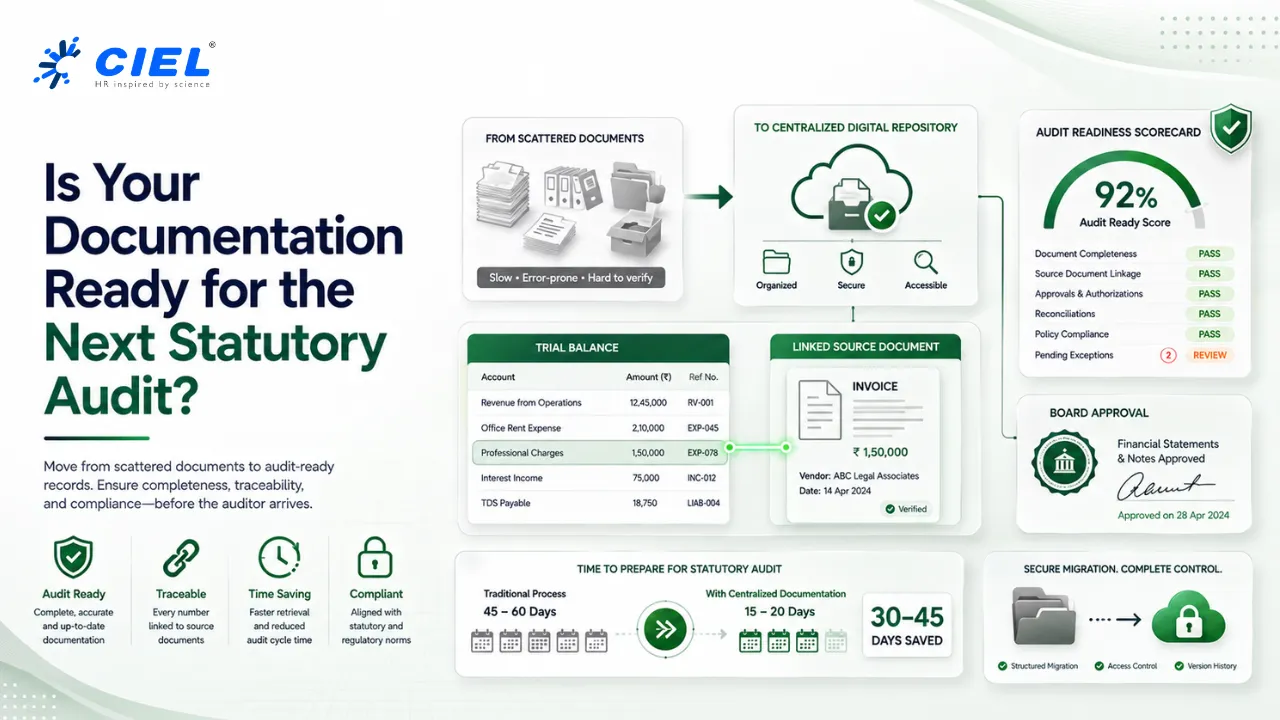
Continuous audit preparation platforms centralize financial records into a unified repository where financial teams link transactions to source documents, reducing audit completion time by 30 to 45 days.
How Do Digital Records Impact Statutory Audit Documentation?
Cloud accounting systems structure unstructured financial data into normalized relational databases. This centralization provides auditors with direct, read-only access to real-time general ledgers. The capability eliminates manual file transfers and reduces reconciliation errors by up to 15%.
Understanding how digital records and cloud accounting systems impact statutory audit documentation is critical for modern finance departments. Instead of hunting through physical filing cabinets, controllers map trial balances directly to digital invoices. This answers the fundamental question of how to organize financial records to make a statutory audit more efficient. Furthermore, digital systems automatically flag missing dependencies. For instance, why do auditors need to review board meeting minutes and legal agreements? They review these to verify corporate governance and identify undisclosed liabilities. A digital system ensures these legal documents are permanently linked to the relevant capital expenditure entries.
Audit Readiness Validation Criteria
- Trial Balance Reconciliation: Variance > 0% = FAIL. Action: Investigate unmapped journal entries immediately.
- Board Approval Linkage: Capital expenditures > $50,000 without attached board minutes = HIGH RISK. Action: Secure signatures before audit commencement.
- Invoice Metadata Completeness: Missing vendor tax IDs > 5% of total volume = FAIL. Action: Execute bulk vendor data update.
What Are the Consequences of Missing Documentation During a Statutory Audit?
Incomplete audit documentation triggers substantive testing expansion by external auditors. This escalation forces finance departments to manually reconstruct historical transactions. The resulting delays push reporting timelines past regulatory deadlines.
A regional manufacturing headquarters sits in a state of quiet panic on a Thursday morning during year-end closing. The external audit team requested the supporting depreciation schedules and capital expenditure approvals for three newly acquired robotic assembly lines. The finance director assumed the plant manager uploaded the signed vendor contracts to the central corporate drive back in the second quarter. They did not.
The plant manager resigned two months prior, leaving the original equipment manufacturer agreements locked in an inaccessible local hard drive. This is passive record-keeping failing in real time. The asset values exist on the balance sheet, but the legal proof of ownership and board approval does not. The auditors immediately expand their sample size, halting the review of standard operational expenses to focus entirely on the missing capital expenditure documentation. The entire audit timeline stalls.
If the facility deployed an active continuous compliance system, the outcome plays out differently. In the second quarter, when the $2.5M invoice hit the accounts payable ledger without a linked board approval document, the system flags the missing dependency and pushes an alert to the controller’s dashboard. The controller secures the digital signature from the plant manager the same day. The documentation gap closes months before the auditors arrive.
How Does Centralized Record-Keeping Compare to Traditional Methods?
Centralized audit repositories aggregate compliance evidence into unified digital environments . This architecture allows stakeholders to track document versions and approval histories systematically. The approach prevents the data silos inherent in legacy manual tracking.
| Feature | Centralized Digital Records | Traditional Manual Tracking |
|---|---|---|
| Data Retrieval | Instant search via relational metadata | Manual folder navigation and email searches |
| Version Control | Automated timestamping and audit trails | Prone to duplicate files and overwritten data |
| Auditor Access | Secure role-based portals | Encrypted email attachments and physical drives |
| Missing File Detection | Automated alerts upon ledger entry | Discovered during active audit review |
What Are the Limitations of Digital Audit Workflows?
Digital audit workflows require strict adherence to data governance protocols to function correctly. This dependency means organizations must invest in change management before realizing efficiency gains. The framework struggles when legacy systems cannot export structured data.
Considerations before implementation:
- Organizations lack a standardized chart of accounts across subsidiaries.
- Subsidiaries operate on entirely offline legacy enterprise resource planning systems.
- Internal teams refuse to abandon localized spreadsheet tracking, creating parallel unverified ledgers.
Evaluate your current documentation readiness to ensure your next statutory audit proceeds without critical delays.
Frequently Asked Questions
How do cloud accounting systems integrate with existing enterprise resource planning software?
Cloud accounting systems pull data from legacy enterprise resource planning platforms via REST APIs or secure file transfer protocols. This integration synchronizes general ledgers with source documentation automatically.
What is the typical return on investment timeframe for continuous audit software?
Organizations recover their initial software investment within 12 to 18 months. The savings stem from reduced external auditor billable hours and fewer internal resource disruptions.
How does a digital compliance repository match invoices to ledger entries?
Digital compliance repositories utilize optical character recognition and relational database mapping to link invoice metadata with corresponding journal entries. This automated matching creates a seamless audit trail for every transaction.
What are the legal requirements for retaining audit-related documents after the audit is complete?
Most regulatory jurisdictions mandate that organizations retain financial records and audit documentation for a minimum of seven years. This retention period ensures historical data remains accessible for future tax reviews or legal inquiries.
What are the most common record-keeping mistakes that delay a statutory audit?
Failing to reconcile intercompany transactions and neglecting to document board approvals for major expenditures are the most frequent errors. These omissions force auditors to pause their review while internal teams manually reconstruct the events.
How should a company organize financial records to make a statutory audit more efficient?
Companies should categorize financial records by financial statement line item and link every trial balance account directly to its supporting source document. This hierarchical structure allows auditors to trace figures back to their origins instantly.
