

Table of Contents
How to Avoid Implementation Pitfalls in Talent Acquisition Overhauls
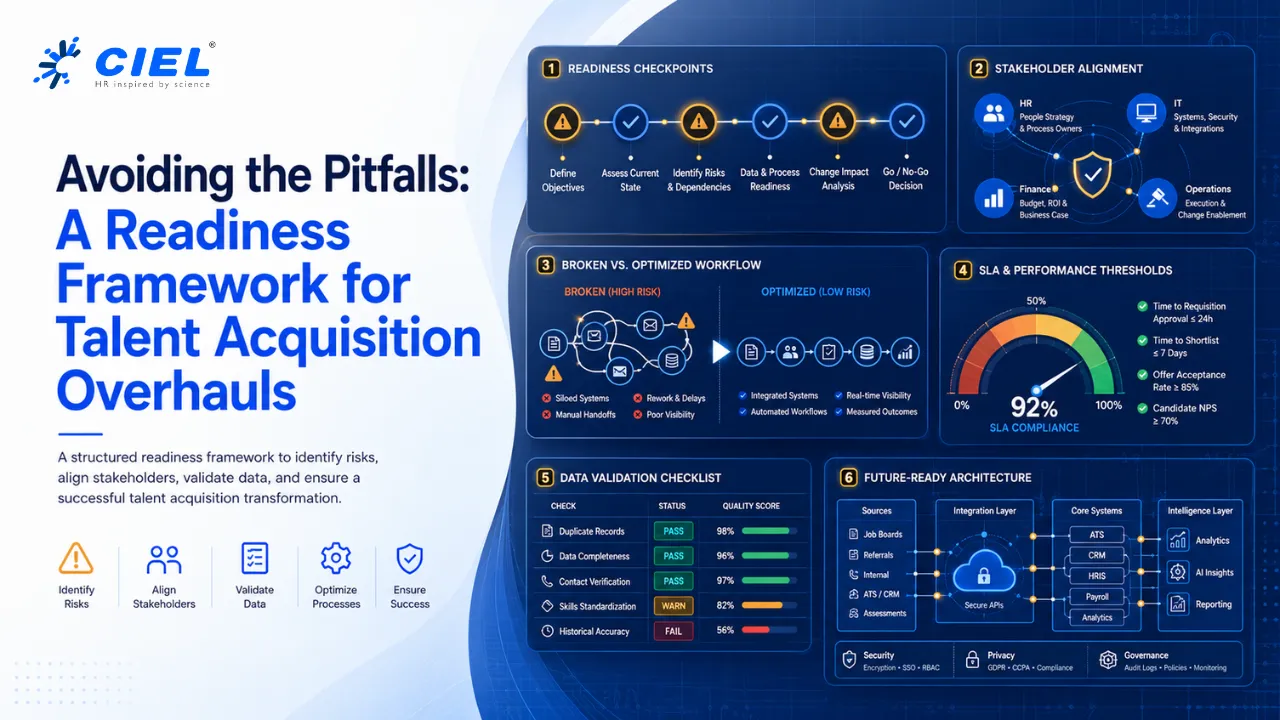
The most effective approach to modernizing talent acquisition workflows requires aligning API data schemas across legacy HRIS platforms before deploying new automation layers. Enterprise ATS implementations fail when organizations automate broken processes without standardizing data fields or securing cross-departmental buy-in. By mapping integration prerequisites and enforcing strict migration thresholds, organizations reduce deployment delays by 40% and ensure continuous candidate data synchronization.
How Do Organizations Validate Readiness for Talent Acquisition Modernization?
Enterprise ATS modernization requires synchronizing legacy HRIS databases with new automation layers via REST APIs. This approach prevents data fragmentation and ensures continuous candidate telemetry. Organizations must resolve existing process inefficiencies before configuration begins.
Procurement and IT teams face a critical validation checkpoint before finalizing the deployment of a new platform. The decision hinges on whether the current database infrastructure can support high-frequency API calls and if cross-departmental stakeholders agree on the baseline configuration limits. Proceeding without strict data migration thresholds guarantees post-deployment failure.
Organizations evaluating deployment timelines must address what are the risks of automating a broken hiring process and how to fix it first. Mapping current delays to specific workflows prevents the system from executing flawed logic at scale. Securing approval requires knowing how to get buy-in from IT, HR, and finance for a talent acquisition system overhaul. Teams must present a unified procurement dashboard detailing API infrastructure costs, compliance SLA metrics , and projected headcount savings.
What Are the Key Constraints When Overhauling Hiring Technology?
Cross-functional alignment establishes strict SLA thresholds for system uptime and data migration accuracy prior to software deployment. This governance structure forces IT, HR, and finance to agree on configuration limits. The resulting framework prevents scope creep during the rollout phase.
Technical evaluators frequently ask how can we ensure our new hiring tools integrate properly with our existing HR tech stack . The solution involves defining webhook endpoints and validating JSON payloads against the legacy database schema. Without this architectural blueprint, systems will reject incoming data packets, leading to immediate operational downtime.
Operations directors evaluate what are the best strategies for managing change when introducing new recruiting technology. Phased rollouts based on department readiness scores minimize operational disruption. Departments that fail to meet baseline competency metrics remain on legacy systems until they pass simulation testing.
How Do You Execute Data Migration and System Integration?
Automated data migration scripts map legacy candidate profiles to new JSON schemas, filtering out duplicate or corrupted records. This mechanism ensures high-fidelity data transfer while maintaining compliance with local data retention laws. Strict validation thresholds dictate whether a migration batch passes or fails.
Engineers must audit what are the most common data migration mistakes when implementing a new applicant tracking system . Failing to sanitize legacy records before batch processing causes duplicate entries and triggers rate limit errors across the network. To prevent these failures, IT teams utilize the following operational authority block for migration validation:
- Data Mapping Accuracy: Match rate >99% = PASS. Match rate <99% = HIGH RISK. Action: Halt migration script and re-map baseline schema.
- API Latency: Response time <200ms = PASS. Response time >200ms = FAIL. Action: Provision additional edge nodes before proceeding.
- System Uptime SLA: Guaranteed availability >99.9% = PASS. Availability <99.9% = FAIL. Action: Reject vendor deployment until redundancy is proven.
What Are the Measurable Outcomes of a Correct Implementation?
Role-based training modules simulate live system environments, forcing recruiters to execute standard workflows before gaining production access. This verification protocol reduces post-deployment support tickets by up to 60%. High user adoption directly correlates with accelerated ROI timeframes.
Administrators must determine how do you design a training program that ensures high user adoption for new recruiting software. Role-based sandbox environments allow teams to execute mock workflows before production deployment. Configuration settings dictate how to balance automation and the human touch to maintain a positive candidate experience. Algorithmic screening filters the top 10% of applicants, while human recruiters conduct qualitative interviews for final selection.
| Feature | Enterprise ATS | Legacy On-Premise Systems |
|---|---|---|
| Core Mechanism | Cloud-based JSON payload routing | Manual CSV batch uploads |
| API Integration | Bidirectional REST APIs (<200ms latency) | Unidirectional scheduled scripts |
| Deployment Timeline | 60 to 90 days | 6 to 12 months |
| User Adoption Rate | >85% within first quarter | <40% requiring constant IT support |
What Are the Trade-offs of Adopting Automated Talent Workflows?
High-volume automation filters candidate pipelines using algorithmic scoring, which occasionally rejects non-traditional resumes lacking specific keyword densities. This trade-off requires human oversight to audit rejected profiles periodically. Organizations must balance processing speed with qualitative review thresholds.
- Algorithmic Rigidity: Strict schema mapping occasionally flags highly qualified candidates if their resume formatting breaks the parsing logic.
- Initial Deployment Delays: Enforcing a 99% data mapping accuracy threshold extends the pre-deployment phase by several weeks.
- Resource Allocation: Maintaining API integrations requires dedicated IT engineering hours, shifting workload from HR to technical departments.
Start validating your infrastructure today by booking a technical scoping session to map your legacy HRIS schema against modern deployment standards.
Frequently Asked Questions
How do new talent acquisition platforms integrate with legacy HRIS databases?
Enterprise ATS platforms utilize REST APIs to establish bidirectional data synchronization with legacy HRIS databases. This integration requires mapping specific JSON payloads to ensure continuous updates of candidate profiles without manual intervention.
What is the typical ROI timeframe for an enterprise applicant tracking system?
Organizations typically achieve full ROI within 8 to 12 months post-deployment. This metric depends on reducing time-to-hire by at least 30% and eliminating redundant software licensing costs across disparate departments.
How does algorithmic resume parsing work mechanically?
Algorithmic parsing extracts unstructured text from candidate resumes and converts it into structured data fields using natural language processing. The system then scores these fields against predefined job description schemas to rank applicants automatically.
How do automated workflows impact candidate communication?
Automated workflows trigger predefined email or SMS webhooks based on specific status changes in the pipeline. This ensures immediate updates for applicants while freeing recruiters to focus on qualitative interview stages.
What happens if the API rate limit is exceeded during data migration?
Exceeding API rate limits causes the endpoint to return a 429 Too Many Requests error, halting the data transfer. Engineers must configure exponential backoff algorithms within the migration script to pause and retry the payload delivery.
How do organizations measure user adoption post-deployment?
Administrators track user adoption by monitoring daily active logins, workflow completion rates, and the volume of support tickets submitted. Low adoption rates trigger mandatory re-enrollment in role-based sandbox training environments.
