
Table of Contents
How Do Talent Acquisition Leaders Evaluate a Remote Recruiting Tech Stack?
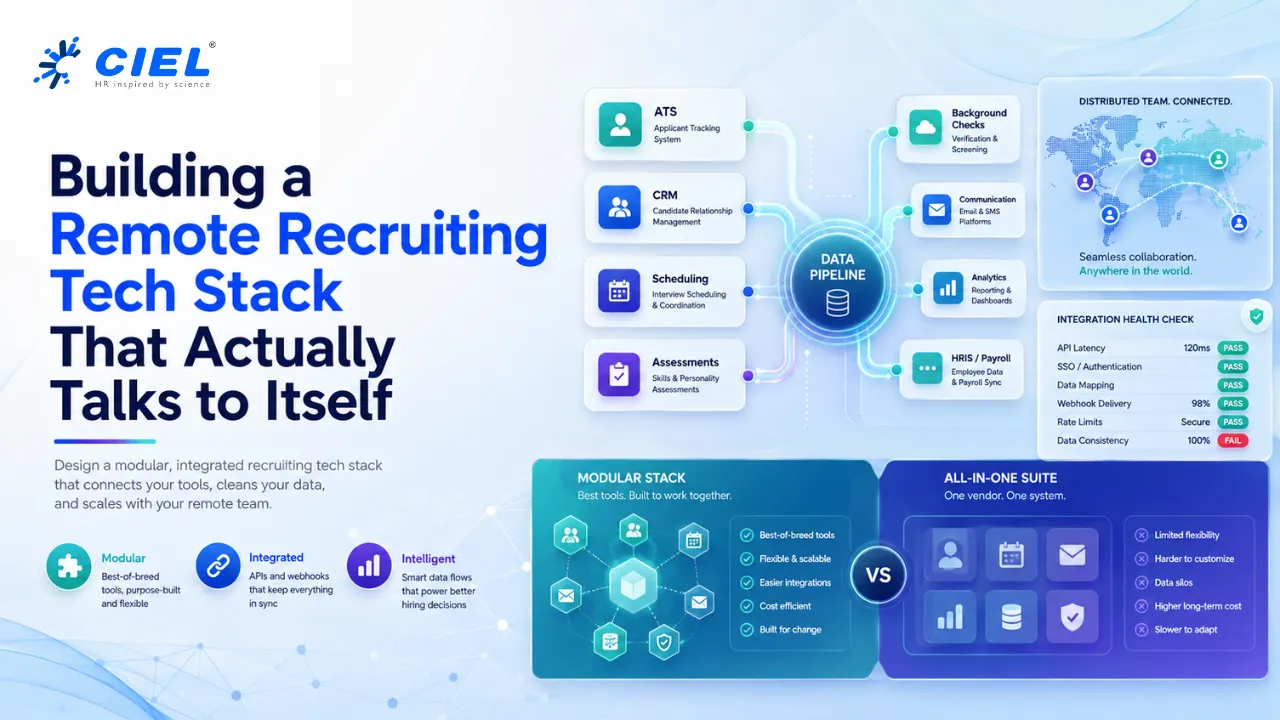
A modular remote recruiting tech stack connects an Applicant Tracking System (ATS) and sourcing automation via Application Programming Interface (API) webhooks, generating a unified candidate data pipeline. This eliminates manual data entry and reduces time-to-hire by 15-30%.
The default approach to evaluating these tools relies on feature checklists rather than data flow analysis. Teams purchase isolated point solutions for video interviewing and background checks, only to discover that manual data entry is required to move candidates between stages. Evaluating a remote recruiting tech stack requires shifting the focus from interface aesthetics to data portability, ensuring that candidate information flows seamlessly across all operational nodes.
What Are the Most Critical Components of a Recruiting Tech Stack for Improving the Remote Candidate Experience?
Candidate experience platforms utilize automated scheduling algorithms to parse interviewer calendar availability, generating self-service booking links for applicants. This eliminates email ping-pong and accelerates the interview phase.
Beyond an ATS, the essential tools for automating the sourcing and engagement stages of remote recruiting include AI-driven candidate relationship management (CRM) software and automated technical assessment platforms. These components work together to maintain continuous communication with applicants. When candidates apply from distributed locations, automated engagement workflows trigger status updates and next-step instructions. This structured communication prevents candidate drop-off during the critical evaluation window.
How Do I Ensure Different Remote Recruiting Tools Integrate Seamlessly?
Native API integrations utilize RESTful endpoints to synchronize candidate records across scheduling software and the core Applicant Tracking System (ATS) in real-time. This ensures that interview data populates instantly within the central database without manual updates.
To guarantee that different remote recruiting tools like an ATS and scheduling software integrate seamlessly, operations teams must validate vendor integration capabilities against strict technical thresholds. Relying on marketing claims about “seamless integration” results in broken workflows and isolated data silos.
- API Latency: >500ms response time = HIGH RISK. <200ms response time = PASS. Action: Require a vendor Service Level Agreement (SLA) guaranteeing webhook delivery speeds.
- Data Mapping: Hardcoded field requirements = FAIL. Custom bidirectional field mapping support = PASS. Action: Verify that custom candidate attributes can map directly to the ATS.
- Authentication standards: Basic authentication = FAIL. OAuth 2.0 or SAML SSO = PASS. Action: Reject vendors that do not support modern identity protocols.
What Happens When Teams Evaluate Recruiting Software Without Integration Thresholds?
A talent operations team at a hyper-growth software firm sits down to finalize the purchase of a dedicated asynchronous video interviewing platform. The scorecard heavily weights user interface, candidate recording quality, and custom branding features. The vendor passes all feature requirements with high marks. The procurement team signs the annual contract, assuming the stated “ATS integration” checkbox guarantees seamless operation.
Two weeks into deployment, the operational gap surfaces. The integration only pushes a generic hyperlink back to the core Applicant Tracking System (ATS), rather than embedding the video file or the interviewer scorecard data. Recruiters must now copy and paste notes between two different browser tabs for every candidate. The platform was evaluated on its standalone capability, completely missing the data payload requirements for the actual workflow.
A properly structured evaluation catches this immediately. When the operations team requires a sandbox test of the JSON payload before signing, they see exactly what data transfers across the API. They reject tools that only pass URLs and mandate vendors that support bidirectional field mapping. The evaluation shifts from interface aesthetics to data portability.
Buying isolated features creates operational friction; buying integrated data flows scales hiring capacity.
What Is the Difference Between an All-in-One Recruiting Platform Versus a Modular Tech Stack?
Modular recruiting tech stacks deploy specialized point solutions connected via middleware, overriding the limitations of monolithic systems. This allows organizations to swap out underperforming modules without replacing the entire database infrastructure.
Understanding the difference between an all-in-one recruiting platform versus a modular, best-of-breed tech stack dictates how an organization scales its hiring operations. All-in-one platforms provide a single vendor relationship but often feature surface-level capabilities across secondary functions.
| Evaluation Criteria | Modular Tech Stack | All-in-One Platform |
|---|---|---|
| Implementation Speed | Requires middleware and API mapping (4-8 weeks) | Turnkey deployment with native modules (1-3 weeks) |
| Feature Depth | Specialized, deep functionality per stage | Broad but shallow functionality across stages |
| System Agility | High: Replace single tools without disruption | Low: Locked into vendor upgrade cycles |
| Data Integration | Relies on OAuth 2.0 and API webhooks | Native internal database synchronization |
How Should I Budget for a Remote Tech Stack Based on Company Size?
Tiered licensing models calculate recruiting software costs based on active job slots or annual hiring volume rather than total employee headcount. This aligns procurement expenditure directly with talent acquisition output.
Determining how you should budget for a remote recruiting tech stack based on your company’s size and hiring volume requires analyzing the cost-per-hire metric. Organizations processing fewer than 50 hires annually must prioritize core ATS functionality over advanced AI sourcing modules. Conversely, enterprise teams processing over 200 hires annually achieve cost efficiency by investing heavily in automated screening tools that reduce manual recruiter hours.
What Are the Key Security and Data Compliance Features to Look For in Remote Hiring Software?
Role-based access control (RBAC) restricts candidate data visibility based on strict user permissions, preventing unauthorized access to sensitive personally identifiable information (PII). This ensures compliance with GDPR and CCPA frameworks during distributed hiring operations.
When identifying what the key security and data compliance features to look for in remote hiring software are, evaluators must look beyond basic encryption. A highly secure modular stack introduces operational realities that organizations must navigate.
What Are the Trade-offs of a Highly Secure Modular Stack?
- Not suitable when IT resources are limited and cannot manage multiple SSO configurations across different vendors.
- Requires continuous auditing of API endpoints to verify that candidate data is not leaking between disconnected systems.
- Strict data residency requirements limit the pool of available software vendors for global hiring operations.
How Can I Build a Scalable Recruiting Tech Stack That Supports Future Team Growth?
Scalable recruiting architectures utilize cloud-native Applicant Tracking Systems (ATS) with open API ecosystems, enabling the seamless addition of new assessment and onboarding modules. This prevents the need for a complete system migration when hiring volume doubles.
To build a scalable recruiting tech stack that supports future team growth, talent leaders must prioritize data schema flexibility. As the organization expands, the system must accommodate custom workflows for different departments without requiring hardcoded developer intervention.
Compare your current integration capabilities against industry API benchmarks to identify existing data silos before signing your next software contract.
Frequently Asked Questions
What technical prerequisites are required to integrate a new CRM with an existing ATS?
Integrating a candidate relationship management (CRM) tool requires the existing Applicant Tracking System (ATS) to support RESTful API endpoints and bidirectional data syncing. Organizations must verify that both platforms use compatible authentication protocols, such as OAuth 2.0, to ensure secure data transfer.
How long does it take to see a return on investment after deploying automated scheduling tools?
Organizations achieve a measurable return on investment within 3 to 6 months of deploying automated scheduling tools. This ROI is calculated by measuring the reduction in recruiter administration hours and the decrease in overall time-to-hire metrics.
How do automated technical assessment platforms grade remote coding tests?
Automated technical assessment platforms execute candidate code within secure, isolated container environments. The system runs predefined unit tests against the submitted code, generating a pass or fail score based on logic accuracy, execution speed, and resource consumption.
When should a company transition from spreadsheets to a dedicated applicant tracking system?
A company must transition to a dedicated Applicant Tracking System (ATS) when hiring volume exceeds 20 to 30 active candidates per month. Beyond this threshold, manual tracking creates data compliance risks and significantly increases the probability of losing qualified candidates to communication delays.
How does single sign-on (SSO) improve security for remote hiring teams?
Single sign-on (SSO) centralizes authentication through a single identity provider, requiring recruiters to verify their credentials only once to access the entire software stack. This eliminates weak passwords and allows IT administrators to instantly revoke access across all platforms if a device is compromised.
