

Table of Contents
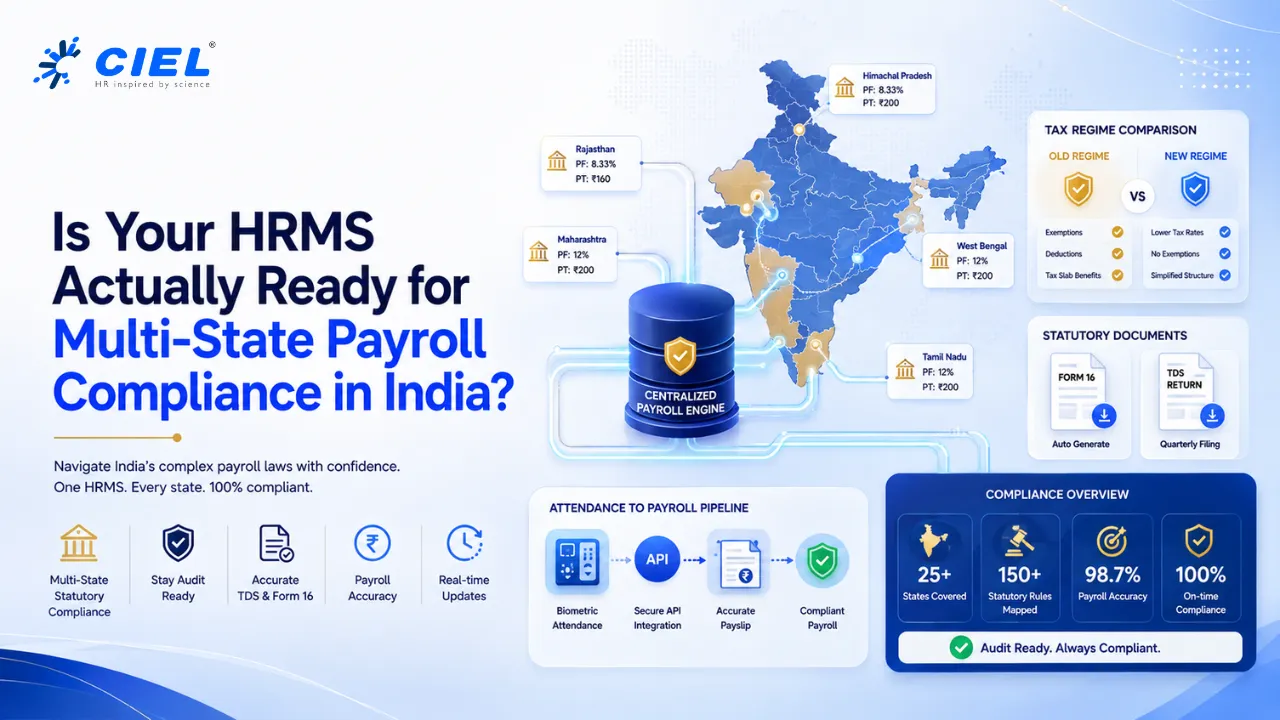
An Indian HRMS processes payroll by mapping state-specific statutory rules against centralized employee data. This mechanism ensures simultaneous compliance with PF, PT, and LWF regulations across multiple jurisdictions. Organizations use this architecture to eliminate manual tax recalculations during disbursement. Evaluating these platforms requires determining whether the system dynamically adapts to fragmented statutory regulations without manual intervention, processing variable pay and attendance data through automated pipelines to ensure final disbursements match regulatory requirements precisely.
What Makes an Indian HRMS Truly Compatible With Complex Payroll Demands?
An Indian HRMS evaluates multi-state payroll compliance by isolating regional statutory rules into dynamic configuration tables rather than hardcoded scripts. This architecture enables the platform to calculate Provident Fund (PF), Professional Tax (PT), and Labour Welfare Fund (LWF) deductions simultaneously across different state jurisdictions. The resulting data pipeline ensures that organizations maintain strict adherence to local labor laws without forcing HR administrators to manually reconcile regional tax variations.
Evaluating an Indian HRMS requires determining whether the platform dynamically adapts to fragmented statutory regulations without manual intervention. Organizations must assess if the architecture natively supports simultaneous deductions while maintaining compliance with both new and old tax regimes. A compatible HRMS processes variable pay, allowances, and attendance data through automated pipelines, ensuring that final disbursements match regulatory requirements precisely.
Why Do Standard HRMS Evaluations Fail to Address Multi-State Compliance?
Legacy HR platforms handle multi-state compliance by relying on static rule engines that require manual database updates. This approach fails when state governments modify tax slabs mid-year, leading to calculation discrepancies and delayed disbursements. Evaluating dynamic rule engines prevents these compliance penalties by ensuring the system updates statutory parameters automatically via cloud-based compliance patches.
Standard evaluation frameworks treat payroll as a generic output rather than a localized, data-driven process. Organizations assume that basic tax calculators scale across multiple Indian states, only to discover that legacy systems hardcode compliance rules rather than treating them as configurable parameters. This static approach breaks down when state governments update Professional Tax (PT) slabs or modify Labour Welfare Fund (LWF) contribution rates. The failure to evaluate dynamic rule engines results in significant compliance penalties and extensive manual recalculations.
What Are the Must-Have Features for Integrating Time and Attendance With Indian Payroll Software?
Modern HRMS architectures integrate time and attendance via REST APIs that sync biometric hardware with the central payroll database. This real-time telemetry maps clock-ins against shift policies to calculate overtime and deductions automatically. This automated pipeline reduces timesheet error rates by up to 15% and eliminates the need for flat-file data transfers.
To ensure the HRMS architecture supports error-free attendance syncing, organizations must validate the integration endpoints against strict operational thresholds. The following authority block defines the pass/fail criteria for evaluating attendance and payroll synchronization.
- API Latency Threshold: Sync delay > 5 seconds = FAIL. Sync delay < 2 seconds = PASS. Action: Reject systems relying on batch processing for attendance data.
- Uptime SLA: Endpoint availability < 99.9% = FAIL. Action: Require vendor documentation proving uptime metrics for biometric telemetry ingestion.
- Data Validation Rule: IF raw attendance data contains null values, THEN the system must trigger a webhook alert to the HR admin before initiating the payroll run.
- Shift Configuration: Inability to map overlapping night shifts to a single calendar day = HIGH RISK. Action: Audit the shift policy engine for chronological boundary handling.
How Does a Disconnected HRMS Impact Strategic Workforce Planning?
Disconnected HRMS platforms isolate workforce data from financial forecasting tools. This fragmentation forces HR operations teams to manually reconcile tax declarations against payroll outputs. Integrating these systems ensures accurate TDS deductions and eliminates administrative bottlenecks during the financial year-end.
The HR operations team at a Bengaluru-based IT services firm sat in their final week of the financial year, staring at a massive reconciliation discrepancy. Their existing platform handled basic salary slips, but it required manual exports to process the new and old tax regime declarations. The finance director assumed the recent HRMS upgrade covered automated TDS calculations, but the vendor’s definition of automation was just a flat-file export.
Because the system lacked dynamic tax forecasting, 300 employees had their final quarter TDS deducted at the highest marginal rate due to missing investment proofs that were actually submitted but not synced. The team spent 72 hours manually recalculating Form 16s in spreadsheets, cross-referencing emails against the isolated payroll module. This demonstrates what happens when evaluation criteria prioritize user interface over backend data architecture.
A properly evaluated HRMS prevents this scenario entirely. If the platform featured native ESS integration, employee investment declarations instantly recalculate projected TDS liability across both tax regimes. The system locks the data, generates the Form 16 automatically, and pushes the final ledger entries to the ERP via API. Evaluating the data pipeline rather than just the dashboard saves hundreds of hours in compliance administration .
How Do Legacy Systems Compare to Native Indian Payroll Platforms?
Native Indian payroll platforms utilize localized compliance engines to process regional tax variations. This architecture automatically updates statutory slabs without requiring custom development. Comparing these platforms against legacy systems reveals significant differences in processing speed, data accuracy, and integration capabilities.
| Feature | Native Indian HRMS | Legacy HR Platform |
|---|---|---|
| Multi-State Compliance | Dynamic rule engine with automated PF, PT, and LWF updates | Hardcoded rules requiring manual database patches |
| Tax Regime Handling | Simultaneous calculation of new and old regimes via ESS | Manual spreadsheet reconciliation and flat-file uploads |
| Attendance Integration | Real-time REST API telemetry with webhook alerts | Batch processing via CSV exports |
| System Architecture | Centralized database with JSON payload routing | Isolated modules requiring middleware |
What Are the Trade-Offs of Adopting a Unified HRMS and Payroll System?
Unified HRMS deployments route all workforce and financial data through a single centralized database. This consolidation introduces strict architectural dependencies requiring 99.9% uptime SLAs. Organizations must implement Role-Based Access Control (RBAC) to secure sensitive payroll information and prevent unauthorized data extraction.
Considerations before implementation:
- Single Point of Failure: Consolidating attendance, payroll, and compliance means any server downtime halts all HR operations simultaneously.
- Migration Complexity: Moving historical payroll data requires complex schema mapping to ensure past tax records align with the new database structure.
- Integration Overhead: Connecting the unified HRMS to legacy ERP systems requires custom API endpoints to translate JSON payloads into compatible accounting formats.
- Access Management: Centralized data demands strict RBAC policies to ensure floor managers view attendance telemetry without accessing executive salary structures.
Evaluate your current system against these core compliance thresholds to determine if your architecture supports scalable workforce planning.
Frequently Asked Questions
Beyond payroll, what are the key integrations for an Indian HRMS, such as with accounting or ERP systems?
An HRMS integrates with accounting and ERP platforms via REST APIs to sync ledger entries automatically. This telemetry eliminates manual journal entries, ensures accurate cost center allocation, and maintains financial data integrity across the organization.
What is the ROI timeframe for deploying an automated Indian HRMS?
Organizations achieve ROI within 6 to 9 months of deployment. The financial return is driven by a 15% reduction in payroll processing errors, the elimination of compliance penalties, and the reduction of administrative hours spent on manual tax recalculations.
How does an HRMS automate TDS calculations and Form 16 generation for the new and old tax regimes?
The HRMS ingests employee investment declarations through the ESS portal and processes them through a dynamic tax engine. It calculates liability under both regimes simultaneously, deducts the optimized TDS amount monthly, and generates compliant Form 16 PDFs automatically at year-end.
What employee self-service (ESS) portal features are essential for reducing HR admin tasks in India?
Essential ESS features include automated investment proof submission, real-time tax liability forecasting, digital payslip access, and direct leave or attendance regularization. These self-service endpoints reduce HR administrative overhead by pushing data entry directly to the employee.
How to configure flexible salary structures with variable pay and allowances in an HRMS for Indian employees?
Administrators configure flexible structures using dynamic rule engines that map specific allowances to statutory compliance parameters. The system automatically adjusts PF and ESI calculations based on the configured base pay, while processing variable performance bonuses through separate API endpoints.
