

Table of Contents
Navigating EPF and EPS Compliance Across Multiple Locations
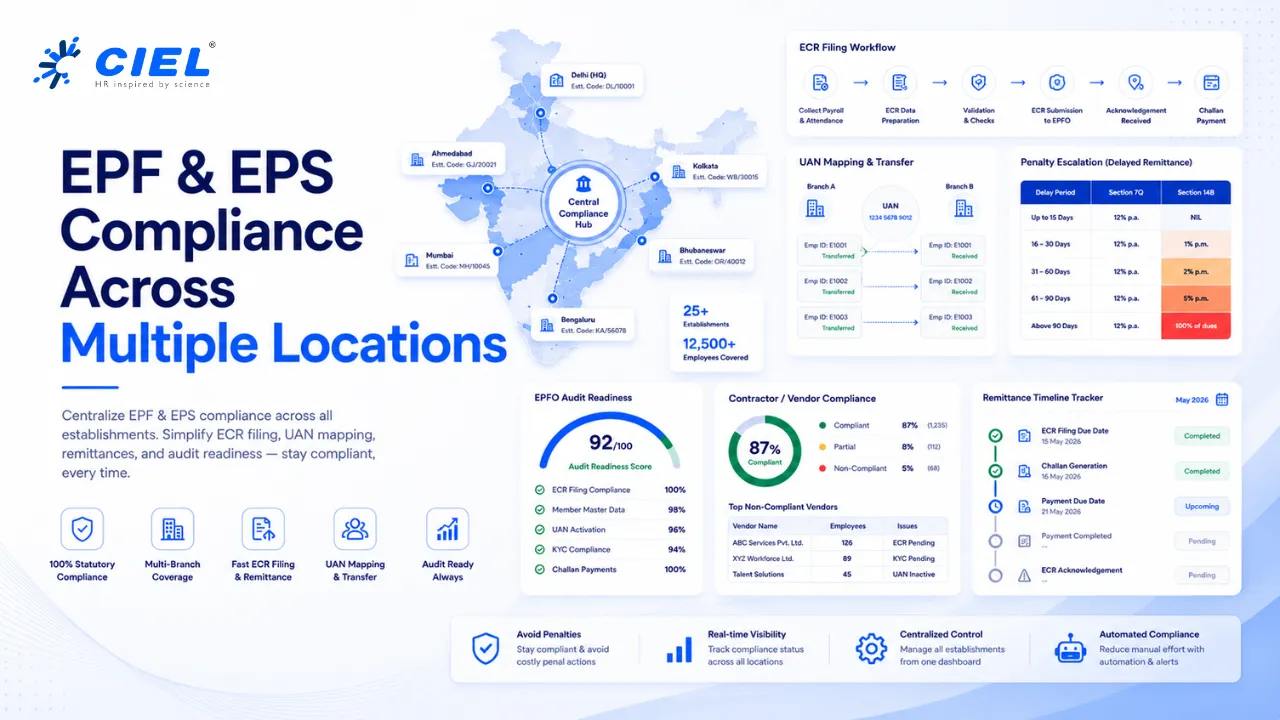
Centralized payroll platforms manage multi-location EPF and EPS compliance by aggregating regional attendance data into a single verified repository. This architecture automates ECR filings, synchronizes UAN updates across branches, and prevents localized statutory defaults. By unifying distributed workforce data, organizations eliminate manual reconciliation errors and maintain continuous visibility against unannounced EPFO audits.
Why Is Multi-Location Provident Fund Compliance So Complex?
Managing statutory contributions across a distributed workforce creates substantial administrative friction for growing enterprises. When organizations expand across state lines, the core challenge shifts from simple payroll calculation to managing fragmented regulatory jurisdictions. HR and finance teams find themselves trapped in a web of overlapping compliance mandates , struggling to maintain visibility over a scattered employee base.
This complexity persists because traditional payroll architectures were designed for single-entity operations. As companies acquire regional offices or deploy remote workforces, they patch together localized compliance processes that operate in silos. The resulting fragmentation leads to delayed filings, mismatched employee records, and an inability to track statutory obligations at the corporate level.
Centralized compliance management platforms consolidate multi-state payroll data into a unified database, automating ECR generation across all regional branches. This eliminates location-based data discrepancies and provides corporate oversight of localized liabilities. The approach requires standardized attendance tracking across all operating locations.
How Does Centralized EPF Management Work?
Centralized payroll systems automate ECR filing and reconciliation by aggregating branch-level attendance and wage data into a single verified repository. This ensures that statutory remittances are processed within the mandated 15-day window. Organizations utilizing this infrastructure reduce compliance processing time by up to 40 percent while maintaining a unified audit trail.
To understand how a centralized payroll system simplify ECR filing and reconciliation for an organization with multiple state-based offices, one must look at the data flow. Regional managers input attendance into local terminals, which instantly sync with the corporate database. The system calculates the exact 12 percent statutory deductions automatically, formatting the data into the precise text file structure required by the regulator.
When expanding operations, administrators must execute the step-by-step process for using Form 5A and member location mapping on the EPFO portal when adding a new branch. First, administrators authenticate into the employer portal. Second, they navigate to the establishment menu and select Form 5A. Third, they input the new branch address, authorized signatory details, and ownership particulars. Finally, they map the newly inducted regional members to the specific location code to ensure accurate regional reporting.
What Are the Trade-offs of Single vs Multiple PF Codes?
A single establishment code consolidates all regional employees under one primary provident fund registration, streamlining monthly ECR generation and centralized audits . This reduces administrative overhead but limits the ability to isolate regional compliance liabilities if a specific branch faces an inspection. Choosing between single or multiple codes depends on the organization’s corporate structure and localized HR autonomy.
Evaluating the pros and cons of using a single PF code versus multiple regional codes for a business with offices in different states requires a strict operational assessment. A centralized code simplifies corporate reporting, while regional codes insulate the parent company from localized administrative failures.
| Feature | Single Establishment Code | Multiple Regional Codes |
|---|---|---|
| ECR Filing Process | One consolidated monthly upload | Separate uploads per branch |
| Liability Isolation | Entire company audited together | Audits restricted to specific branch |
| Internal Transfers | No UAN transfer required | Requires formal UAN transfer process |
| Administrative Overhead | Low maintenance | High maintenance |
How Do Multi-Location Audits Unfold in Practice?
Automated compliance tracking systems monitor branch-level remittance timelines and flag discrepancies before they trigger official scrutiny. This proactive mechanism prevents the accumulation of late fees and protects the organization from severe regulatory penalties. Maintaining continuous compliance visibility prevents unannounced operational disruptions.
A regional logistics hub in Pune operates with a mix of permanent staff and third-party contractors managed by three different vendors. During the first quarter, one of the transport vendors delays their provident fund remittance by 20 days. The regional HR manager, relying on manual vendor declarations, assumes all statutory obligations are cleared and files the monthly compliance report. The discrepancy remains buried in paper ledgers.
Because the enterprise operates under a single centralized PF code, this localized vendor failure acts as one of the common triggers for an EPFO audit for a company with a national footprint and how to prepare for it becomes a critical issue. Two months later, the corporate headquarters in Mumbai receives a notice for an unannounced inspection. The audit freezes the entire organization’s compliance status, forcing the corporate finance team to spend weeks manually reconciling contractor data from the Pune facility just to isolate the single point of failure. This is passive vendor management working exactly as designed. The record exists. The response did not.
The same scenario under an active compliance intelligence system plays out differently. On day 16, when the vendor fails to upload their specific ECR file, the centralized platform pushes a webhook to the corporate compliance dashboard. Not a static report, but a direct text payload: Pune logistics hub, vendor ID 4402, 50 contract workers, remittance threshold exceeded. This illustrates exactly how EPF compliance for contract employees work when they are managed by different branches or vendors under strict oversight. The compliance officer immediately withholds the vendor’s invoice payment until the statutory dues are cleared. The corporate entity remains insulated from the vendor’s default. The system audited the vendor before the regulator audited the company.
What Are the Financial Risks of Non-Compliance?
Statutory penalty frameworks impose escalating financial damages on employers who fail to remit provident fund contributions within the mandated timeframe. This creates an exponential liability curve where minor administrative delays quickly compound into significant corporate debt. Organizations must strictly adhere to the statutory deadlines to avoid mandatory interest and damage assessments.
Understanding the specific financial penalties under section 7Q and 14B for late EPF payment by a multi-location employer requires mapping delays against rigid statutory thresholds. The evaluation logic below dictates the mandatory financial consequences for any missed deadline:
- Condition A (Minor Delay): IF remittance delay is less than 2 months, THEN the system assesses a 5 percent annual penalty under Section 14B AND a flat 12 percent annual interest under Section 7Q.
- Condition B (Moderate Delay): IF remittance delay is between 2 and 4 months, THEN the penalty escalates to 10 percent annually under Section 14B AND 12 percent interest under Section 7Q.
- Condition C (Severe Delay): IF remittance delay is between 4 and 6 months, THEN the penalty reaches 15 percent annually under Section 14B AND 12 percent interest under Section 7Q.
- Condition D (Critical Default): IF remittance delay exceeds 6 months, THEN the penalty ranges from 25 percent to a maximum of 100 percent of arrears under Section 14B AND 12 percent interest under Section 7Q.
How Do UAN Updates Work Across Branches?
UAN mapping links an employee’s provident fund history to their current establishment code, ensuring seamless continuity of benefits during internal transfers. This digital linkage prevents the creation of duplicate accounts and facilitates immediate access to accumulated funds. Proper UAN management maintains accurate corporate headcount records.
Administrators must carefully handle employee PF transfers and UAN updates when they move between different branches of the same company. When an employee relocates from a Chennai office to a Delhi branch operating under a different regional code, the HR administrator initiates a transfer request via the employer portal using the employee’s static UAN. The system verifies the KYC details, closes the contribution ledger at the origin branch, and activates the destination ledger without disrupting the underlying pension accumulations.
Discover how automated payroll architectures streamline multi-location compliance strategies and eliminate manual reconciliation.
Frequently Asked Questions
What technical prerequisites are required to implement a centralized compliance platform?
Implementing a centralized system requires standardized attendance tracking hardware across all branches and an API-ready payroll architecture to synchronize daily wage data into the primary repository.
What is the typical ROI timeframe for deploying automated EPF reconciliation software?
Organizations typically recover their software investment within 6 to 8 months by eliminating late remittance fees, reducing manual HR administration hours, and avoiding regulatory damage assessments.
How does the EPFO portal process Form 5A updates for new branches?
The portal validates the digital signature of the authorized signatory to process Form 5A updates, linking the new physical address and ownership details to the primary establishment code.
Can contract workers be managed under a separate establishment code?
Yes, organizations require third-party vendors to maintain their own establishment codes, though the principal employer remains legally responsible for verifying those vendor remittances monthly.
How do regional labor laws intersect with national provident fund mandates?
While regional professional taxes and minimum wage laws vary by state, provident fund mandates operate strictly under central jurisdiction, requiring identical calculation logic across all operating branches.
What happens to employee pensions during an inter-state transfer?
Pension accumulations remain intact during transfers because the digital UAN linkage preserves the continuous service record, regardless of which regional branch processes the monthly payroll.
